Independent Technical Reference & Decision Documentation
Comping Methodology

Lead Vocal Take Architecture Ledger

A rigorous technical workflow for cataloging multi-pass vocal tracking, isolating phrase-level dynamics, and constructing transparent master comp playlists.

September 15, 2026
Marcus Vance
8 min read
Vocal Production
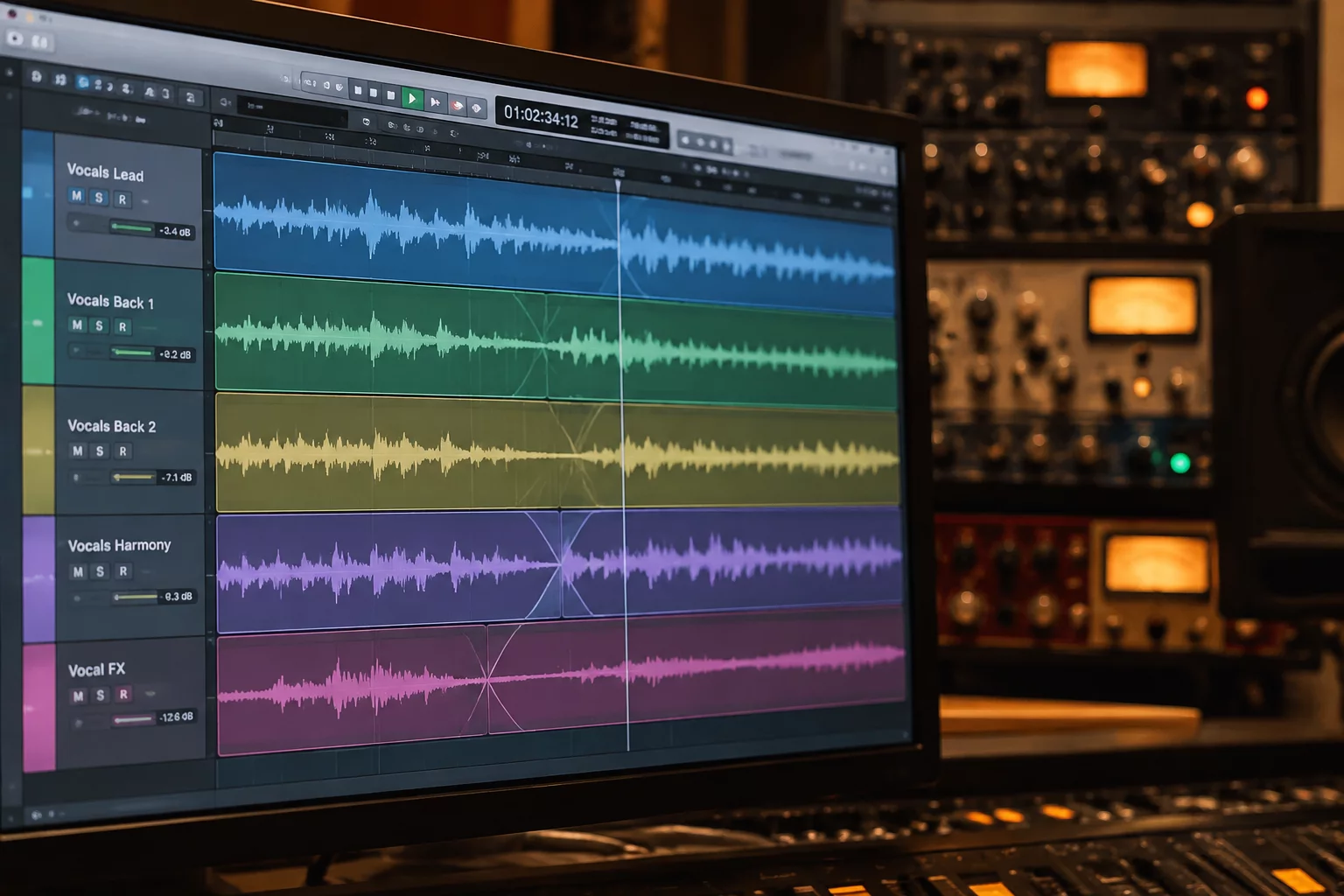
Lead vocal take architecture playlist lanes and crossfade regions in DAW
Ledger Reference #LV-09 Session take hierarchy: Pass lanes 01 through 06 with mapped anchor points
Observable Pitch Stability Consonantal Crispness Natural Breath Retention Phrase Dynamic Contour Sub-Sample Crossfade Align
Evaluation Schema

Vocal Evaluation Architecture & Decision Matrices

Phonetic Transient Capture

Plosive energy and initial consonant articulation audited across takes to preserve rhythmic forward momentum without triggering proximity pops.

Fundamental Pitch Drift

Evaluation of sustained vowel centers against root musical intervals, identifying natural vibrato onset without microtonal sagging.

Intersyllabic Breath Flow

Cataloging inhalation volume, room reverberation spill, and physical chest recovery intervals before downbeat phrase launches.

Dynamic Trajectory Contour

Mapping verse-to-chorus volume inflation, monitoring head voice pressure transitions and avoiding artificial fader rides during selection.

Zero-Crossing Boundary Splicing

Slicing take segments strictly at zero-energy intersections or masking edit splices inside consonant noise bands such as unvoiced fricatives.

Emotional Performance Cohesion

Verifying timbre uniformity and throat warmth between spliced sections to prevent psychological disassociation across adjacent bar lines.

Core Architecture Rules for Master Vocal Assemblies

  • Establish anchor takes per structural song section before auditioning secondary safety variations.
  • Isolate phrase beginnings rather than midpoint vowels when setting crossfade transition boundaries.
  • Never strip inhale breaths completely; attenuate by 3dB to 6dB only if compressor pump reveals room rumble.
  • Commit playlist selections to duplicate playlists before executing destructive corrective time alignment.

Deconstructing the Vocal Pass Matrix: From Raw Takes to Master Lane

Building an impeccable lead vocal requires a systematic dissection of raw performance passes rather than intuitive guesswork. When tracking vocalists across 5 to 8 consecutive takes, subtle physiological fluctuations alter harmonic presence, larynx height, and mouth resonance. Our architecture ledger records each pass on dedicated sub-playlists within Pro Tools, categorizing bars 1 through 16 by pitch stability, phrase dynamics, and consonant delivery. Rather than splicing indiscriminately at arbitrary bar lines, the lead vocal ledger enforces splice decisions positioned immediately before unvoiced consonants like 't', 'k', or 'p'. This masking ensures that edit seams remain virtually undetectable to analytical mastering monitors.

“A flawless vocal comp is not the one with zero pitch errors; it is the composite performance where editorial seams disappear entirely beneath the emotional conviction of the singer.”

— Marcus Vance, Chief Editorial Engineer

Managing Consonants, Sibilance, and Micro-Crossfades

High-frequency sibilance ('s', 'sh', 'z') poses the most treacherous trap during vocal take assembly. When comping takes captured with varying distances from the pop filter, sibilant energy can spike unpredictably between adjacent words. Our ledger mandates checking the 5 kHz to 9 kHz region before locking an edit point. If Take 3 provides a breathtaking emotional vowel on a sustained phrase but possesses a harsh initial sibilant, the opening phoneme can be harvested from Take 1 and crossfaded into Take 3 using an equal-gain 5-millisecond taper right at the vowel onset.

Furthermore, micro-dynamics between breathing intervals dictate the believability of the vocal. Removing natural inhalations strips the human vulnerability from the track and creates jarring psychoacoustic voids in dense pop and rock arrangements. By logging breath waveforms on dedicated playlist lanes, editors can preserve the natural pre-phrase inhalation from the chosen take, maintaining realistic lung pressure curves and seamless vocal identity throughout the piece.

Technical Inquiries

Frequently Addressed Vocal Comping Queries

We recommend capturing four to six continuous full-length passes followed by two targeted punch passes for demanding bridge or chorus sections. Capturing more than eight passes typically introduces vocal cord fatigue, resulting in duller transient response and erratic formant shifts.

The safest edit points lie immediately preceding an unvoiced consonant (such as 't', 'k', 's') or directly within a naturally occurring breath pause. Splicing across sustained resonant vowels often causes audible phase mismatches or formant jumping and should be avoided.

Breaths convey expressive tempo, respiratory cadence, and spatial continuity. Complete silencing of breath regions makes vocals feel synthetic and causes aggressive bus compressors to jump erratically as background room noise drops to digital black.

Marcus Vance

Senior Vocal Editor & Acoustician

Marcus Vance has directed editorial tracking and vocal comping workflows for independent studios across the United States. His documentation focuses on phase-accurate editing, vocal acoustic dynamics, and playlist discipline.

Analyze Industry Take Comparisons & DAW Updates

Explore our technical breakdown of current digital audio workstations, native DSP architectures, and third-party playlist compilation tools.