Independent Technical Reference & Decision Documentation
Comping Methodology & Technical Analysis

Drum Overhead Edit Points and Phase Continuity

Establishing phase-coherent slice boundaries across stereo overhead arrays, room pairs, and direct kit channels during multitrack comping sessions.

September 21, 2026
David Kelling
8 min read
Multitrack Methodology
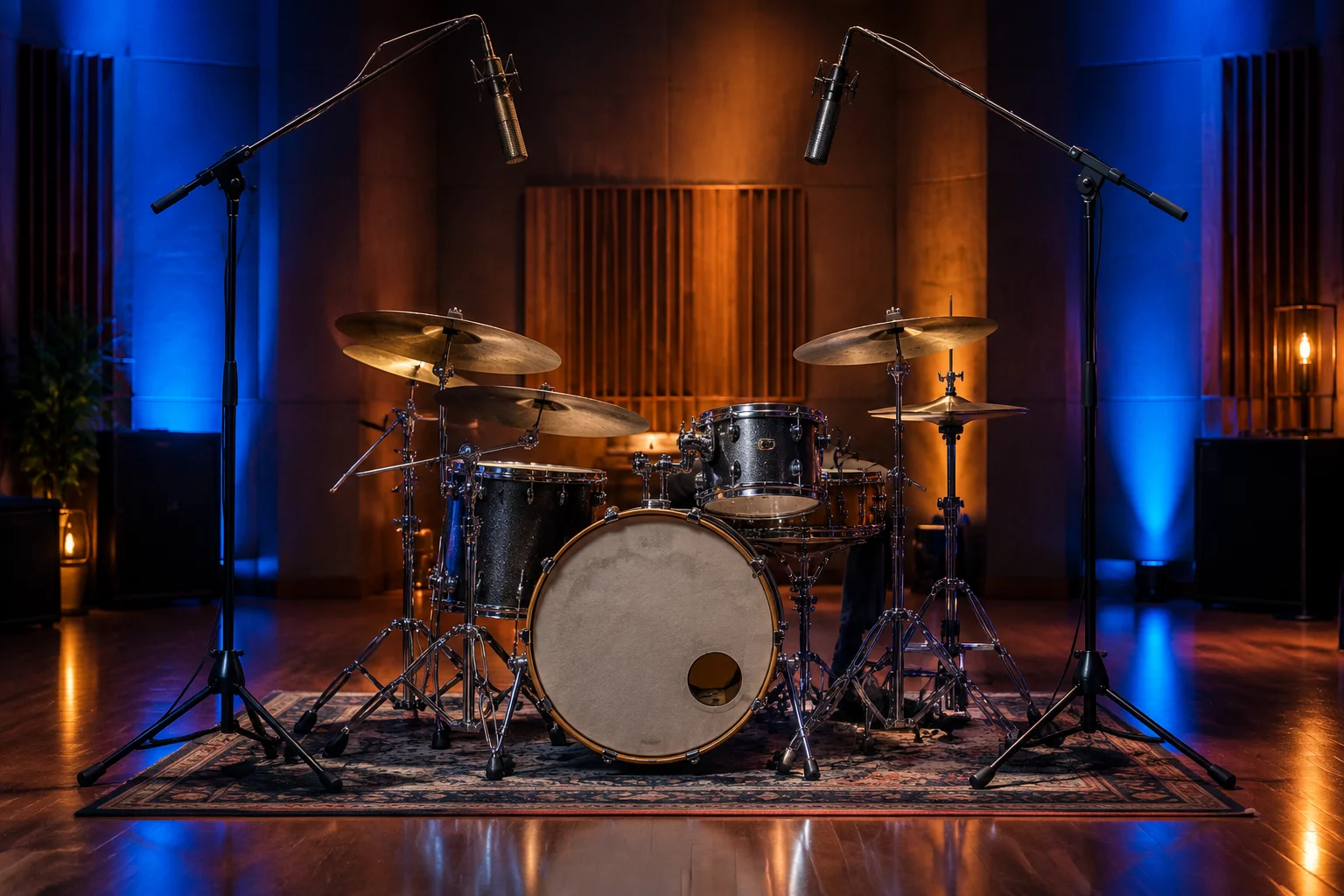
Drum kit in recording live room miked with spaced stereo overhead pair and DAW multitrack edit display
Overhead Phase Ledger Calibrated overhead stereo pair alignment and zero-crossing edit markers across composite drum takes.
Coincident vs. Spaced Pairs Zero-Crossing Snap Snare Bleed Phase Alignment 5ms–12ms Log Crossfades Cymbal Decay Continuity
Engineering Criteria

Core Protocols for Phase-Stable Drum Edits

Transient Leading-Edge Anchor

Slicing directly on kick or snare transients masks cymbal bleed anomalies while preserving natural attack energy across the entire kit.

Spaced Pair Delay Calibration

Spaced overhead mics capture snare transients with physical time differences. Slicing on the earliest mic boundary prevents double-transient smearing.

Cymbal Tail Wash Continuity

Continuous ride or crash decays reveal comb filtering when spliced mid-ring. Take selection favors edits during dead space or active hi-hat chokes.

Multitrack Phase Group Locking

Overhead edits must stay linked to close mics, room mics, and bottom snare feeds. Isolated lane slicing introduces instantaneous comb filtering.

Equal-Power Crossfade Shaping

Linear crossfades introduce a 3dB volume dip during uncorrelated cymbal wash. Equal-power logarithmic shapes sustain constant acoustic energy.

Low-Frequency Polar Verification

Verifying fundamental kick and floor tom polarity in overhead captures avoids sudden low-end hollowed cancellations after composite crossfades.

Critical Technical Takeaways

  • Never slice overhead tracks independently from close spot mics; lock all drum tracks into an edit group before placing razor cuts.
  • Prioritize edit junctions immediately prior to authoritative downbeat snare hits where the crack masks wash disparities.
  • Monitor the stereo field in mono during crossfade scrubbing to detect fleeting comb filtering or image pulling.
  • Audit ride cymbal patterns carefully; alternating ping resonances cause noticeable pitch modulations across disparate takes.

Acoustic Mechanics of Overhead Edit Discontinuities

Comping live drum takes introduces acoustic complications absent in isolated vocal or DI instrument sessions. The overhead microphones do not merely capture cymbals; they register the complete kinetic image of the acoustic drum set, capturing reflections, early room boundaries, and bleed from every shell. When an editor splices between Take 2 and Take 4 at an arbitrary bar line, the acoustic air column moving through the room changes abruptly. If the drummer struck the crash cymbal with marginally different velocity on the incoming take, or if the cymbal swung along an altered physical axis relative to the microphone diaphragms, the phase relationship between the two takes shears instantly. The listener perceives this mismatch not necessarily as a click, but as a sudden hollow suck-out in snare body or an unnerving stereo smear across the high frequencies.

“An overhead cut is never just a splice in time; it is a violent acoustic relocation of every shell, room reflection, and cymbal resonance in the tracking space.”

— David Kelling, Senior Tracking & Editorial Engineer

Systematic Execution: Transient Slicing and Crossfade Geometry

To maintain imperceptible transitions across takes, editors must tether every splice to an acoustic mask. The primary anchor is almost always a decisive transient event, such as a snare crack or kick downbeat. By placing the split point 2 to 4 milliseconds prior to the initial attack transient—during the natural pre-hit acoustic valley—the explosive dynamic burst of the subsequent stroke drowns out the background wash difference. Both channels of the stereo overhead pair must crossfade across this exact sample boundary simultaneously alongside all spot channels.

Furthermore, crossfade geometry demands precision. When joining two active cymbal washes, linear crossfades cause a dip in sound pressure level, whereas excessively long crossfades (greater than 20 milliseconds) create swishing flanging artifacts due to microtonal phase clashes. A steep, equal-power crossfade between 5 and 10 milliseconds cleanly swaps the background noise floor without triggering noticeable comb filtering. If cymbal ring-out differs substantially across takes, the edit point should be relocated to the start of a bar preceded by a tom roll or hi-hat choke rather than forcing a crossfade through an open crash decay.

Technical Ledger FAQ

Overhead Phase and Editing Inquiries

This usually occurs because the phase relationship between the overheads and the close snare mic changed between takes. If the drummer adjusted their seating, struck the snare slightly off-center, or if the overheads were edited without locking spot mic groups, fundamental frequencies in the 150 Hz to 250 Hz range cancel out, robbing the snare of its low-end weight.

Auto-alignment tools can correct static phase relationships across stationary microphones within a single take, but they cannot smoothly reconcile moving cymbal resonance across disparate take edits. Manual zero-crossing placement and transient masking remain the authoritative protocol for edit transitions.

For continuous ride cymbal patterns, short equal-power crossfades between 4ms and 8ms placed immediately before a ride bell or bow strike are recommended. Longer crossfades result in audible flanging because the resonant overtones of the brass do not vibrate at identical phase angles.

David Kelling

Technical Editor & Tracking Specialist

David Kelling has spent two decades recording and editing multitrack acoustic rhythm sections. His ledgers focus on sample-accurate phase alignment, transient integrity, and playlist comping methodologies for high-density session archives.

Examine Studio Comping Decision Ledgers

Explore technical analyses, track grouping methodologies, and editorial case files documented across real-world tracking sessions.