Acoustic Environment and Room Tail Continuity
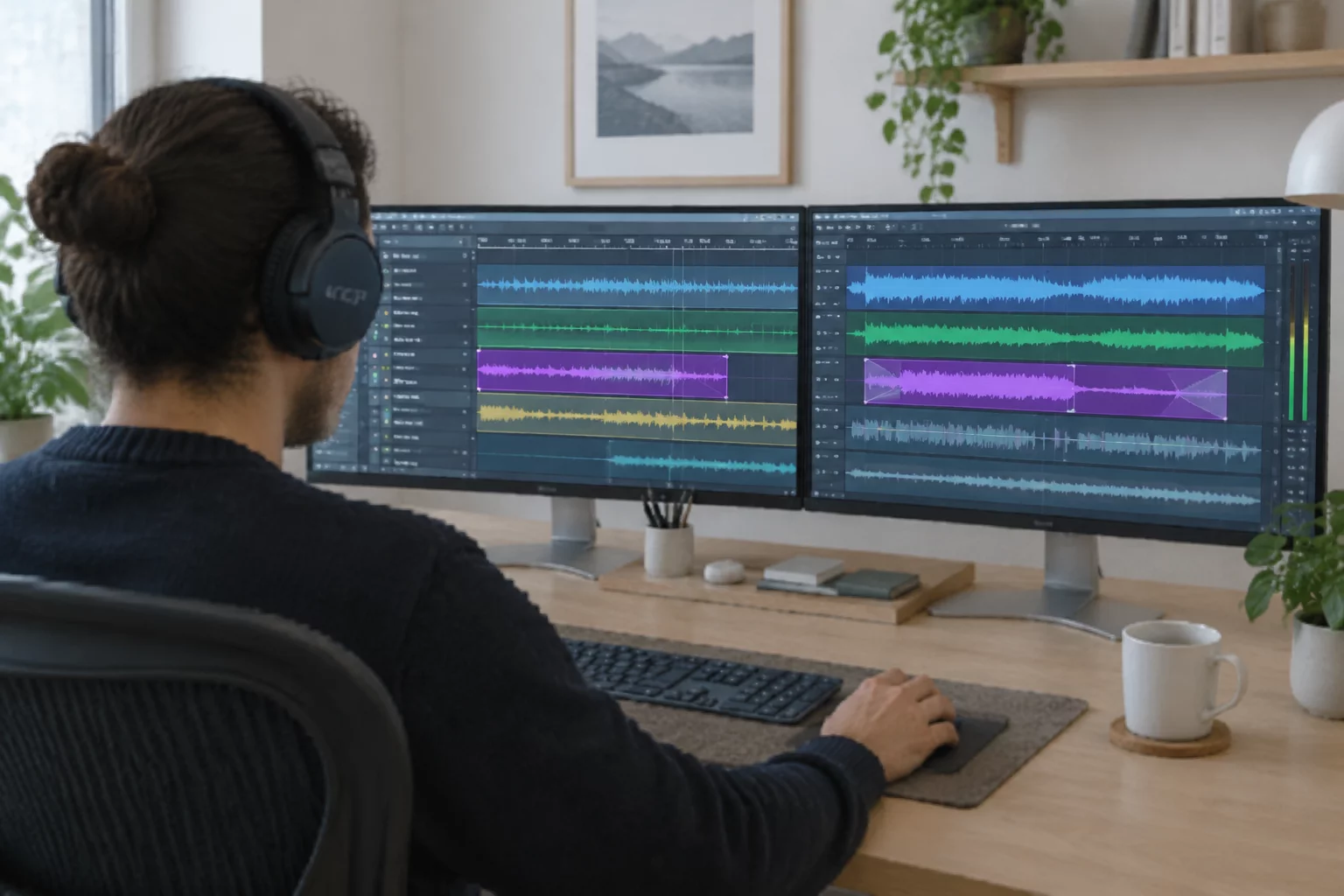
Comping a solo instrument presents challenges distinct from tracking close-mic vocalists or synthetic instruments. When recording acoustic violin, lead guitar, or trumpet in a tracking room, the room itself acts as an instrument. Each take captures not only the dry direct signal from the instrument soundboard or bell, but also complex spatial reflections that decay across hundreds of milliseconds. Splicing between Take 2 and Take 4 at the midpoint of a sustained passage risks abruptly altering the ambient decay envelope. To prevent audible discontinuities, the editor identifies quiet breaths, rests, or rapid staccato notes where the room excitation momentarily settles before committing the edit cut.
— Julian Thorne, Lead Technical Editor“An edited phrase succeeds not when the pitch grid looks immaculate, but when the listener hears an uninterrupted human thought unfolding in real space.”
Preserving Human Micro-Dynamics and Vibrato Modulation
Beyond the physical acoustic space, solo instrument comping requires respect for the musician's physical momentum. A performer naturally alters hand pressure, embouchure tightness, and vibrato frequency across an escalating melodic passage. Assembling a composite solo by alternating bar-by-bar takes often produces an unsettling mechanical patchwork where vibrato width oscillates unnaturally.
The matrix methodology evaluates phrases in complete musical gestures—typically two to four bars in duration—rather than fragmented single notes. When surgical single-note replacement becomes unavoidable to rescue a split note or misfretted tone, editors match the vibrato phase and fundamental harmonic spectrum of the destination segment. Crossfade boundaries are nestled right on the transient crest of the target note, leveraging psychoacoustic masking to conceal the transition.